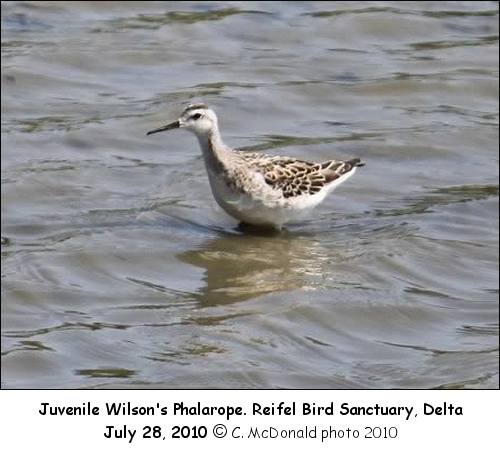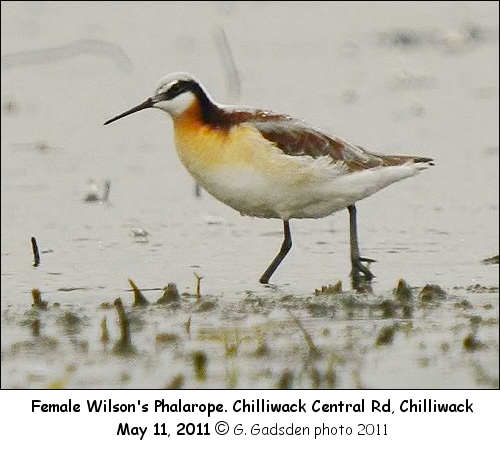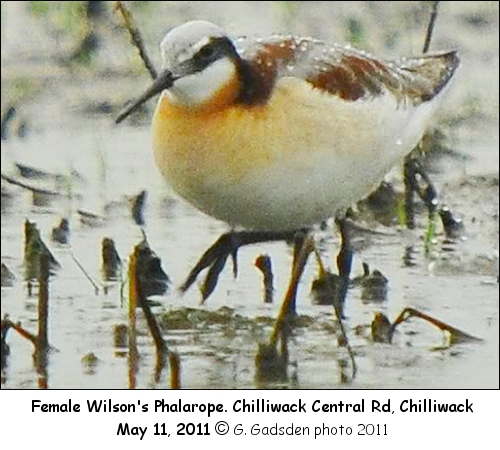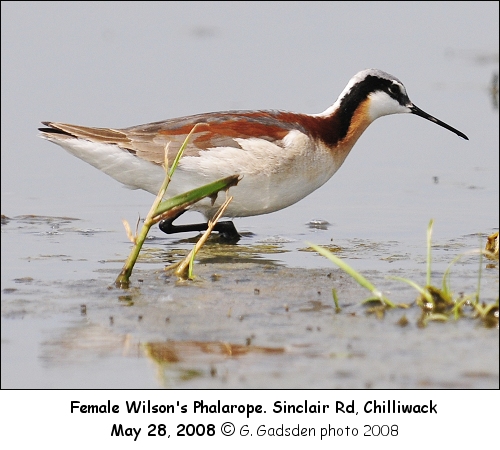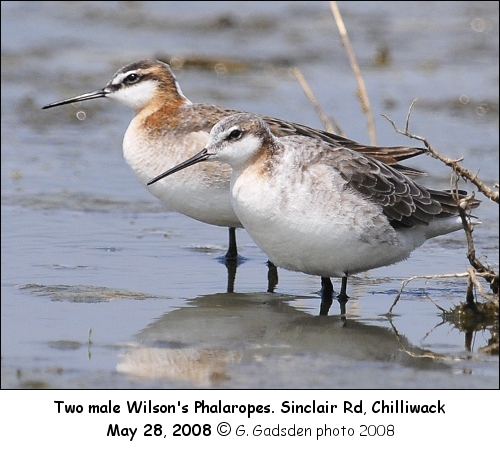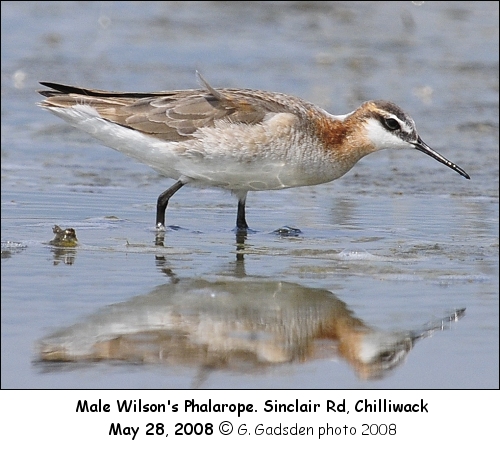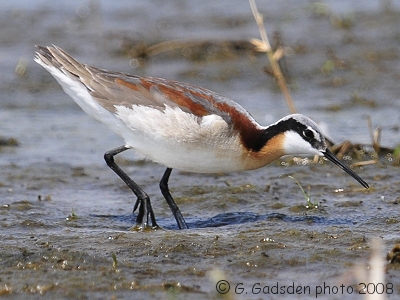

This unique shorebird graces us with its presence during spring and fall migration as it travels between its breeding grounds in the interior of the Province and its wintering grounds in South America. Almost all records for this species in the checklist area occur in the month of May. While shorebird species can swim, none take to it quite like the phalaropes who have dense, bouyant plumage and lobed toes. Phalaropes will feed in shallow water or along the edge of water like other shorebirds, but they will also use their swimming ability in deeper water to pick food off the surface. Adding to their unique feeding habit, they will also spin around in the water like a top to create an upwelling to cause food items to rise up from the bottom so they can reach it. Females are much more brightly coloured than the males in the phalaropes. Also, males are responsible for incubating the eggs and raising the young as the female will often leave after she lays her eggs.
Similar species:
In breeding colours, they are fairly distinctive. Juveniles are similar in a sense to yellowlegs. Red-necked Phalarope juveniles are smaller, darker with more distinct markings on the head and face.
Sources:
Ehrlich, Dobkin and Wheye, (1988)
Sibley, D. (2000)
Noteworthy Data
Date | Location | Source(s) | Comments |
| May 14, 2012 | Hopedale Road, Chilliwack | G. Gadsden 2012l | A male and female in a flooded section of field. |
| May 11, 2011 | Chilliwack Central Rd, Chilliwack | G. Gadsden 2011g | Female with Red-necked Phalarope and other shorebirds in flooded field. Photographed. |
| June 1, 2008 | Whorley Road, Agassiz | K. R. Jones 2008 | Two females in flooded field. Photographed. Also seen on June 4, 2008. |
| May 28, 2008 | Sinclair Road, Chilliwack | G. Gadsden 2008i | A female and two males in a small pond in a field. Photographed. |
| May 22, 2008 | Sinclair Road, Chilliwack | G. Gadsden 2008h | Female. Photographed. |
| May 13, 2004 | Wilband Creek Park, Abbotsford | B. Schmor 2004 | Field notes. |
| May 10, 2002 | Chilliwack | D. Peppar 2002 | Data entered on eBird. |
| September 9, 1888 | Fraser Valley | A. Brooks 1917 | Only fall documentation of this species for the area. |
Photos